Air Conditioner Peptide Testing Laboratories Third-party Peptide Evaluation We will certainly pick one of the most suitable elution solvent for you according to your sample attributes, sample type and the solvent you use to dissolve the example. First, a tiny amount of the peptide is liquified in a fluid and injected into the HPLC machine. That fluid is then pushed through a slim tube (called a column) under high stress. The sample is injected right into the system; as it takes a trip through the column, various elements elute at different times and appear as distinctive tops on the chromatogram. A peptide's HPLC evaluation typically produces a chromatogram showing one dominant top (the target peptide) and potentially smaller sized tops for impurities [3] Checking out an HPLC chromatogram involves noting each optimal's retention time and location. The area of the primary top about the complete location shows the peptide's purity (e.g. a primary top that is 98% of the complete location implies the sample is 98% pure) [5] Researchers very closely examine HPLC results to decide if a peptide is suitable for usage.
When Is Hplc Approach Growth, Recognition, And Hplc Evaluation Made Use Of?
Also reduced degrees of contaminants can change a peptide's biological activity, interfere with architectural evaluations, or disrupt method recognition.
Examinations like molecular weight decision (LC-MS) confirm the molecular weight of the peptide.
Validates molecular identity by matching the observed mass to the theoretical mass.
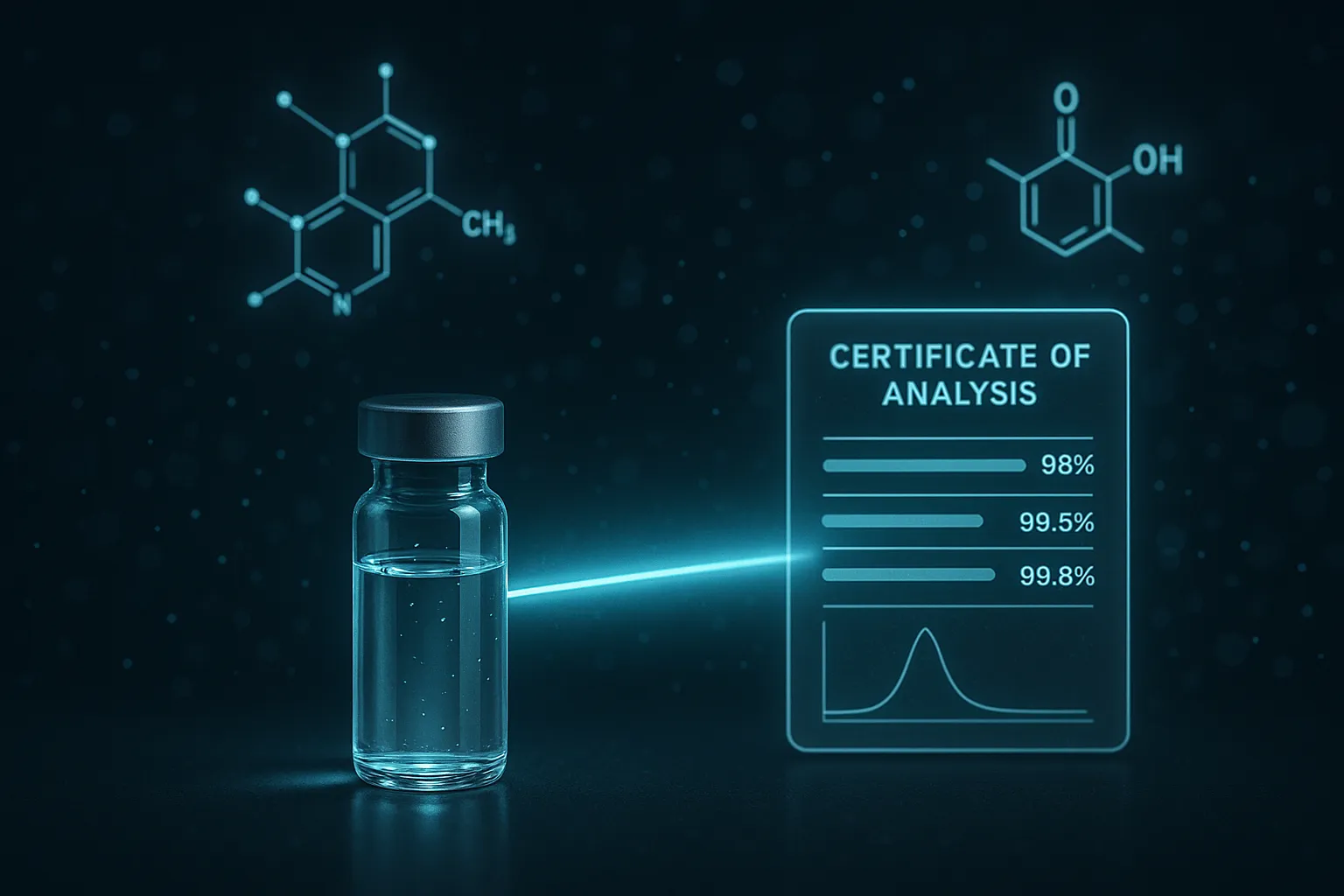
This file must include the HPLC purity percentage, the molecular weight confirmed by mass spectrometry, the peptide sequence, whole lot number, and screening day.
We normally use a slope elution method every min (the focus of acetonitrile rises by 1% every min, v/v), which can prevent the overlap of example tops and impurity tops and boost the precision of analysis results.
Tests like molecular weight decision (LC-MS) confirm the molecular weight of the peptide. Amino acid sequence confirmation (MS/MS) validates that the peptide's sequence is right. MS is particularly practical for discovering contaminations that co-elute (substances that are not totally separated) during chromatography.
Advanced Analytical Services For Trusted Peptide Recognition
Just how much does peptide HPLC testing price?
The price of peptide evaluation solution varies dramatically based on which techniques your governing bundle calls for: HPLC-UV Analysis: $& #x 24; 300 & #x 2013; & #x 24; 800 per example (basic pureness assessment) LC-MS (Fluid Chromatography-Mass Spectrometry): $& #x 24; 600 & #x 2013; & #x 24; 1,500 per sample (molecular weight confirmation).
Regulative companies carefully check peptide items, specifically those made use of in intensified medication under 503a and 503b guidelines. For instance, peptides intensified under 503b centers need to meet higher quality criteria contrasted to 503a facilities, which focus on patient-specific prescriptions. Chromatography is used to separate peptide components and discover contaminations. This strategy consists of HPLC purity analysis and dimension exclusion chromatography (SEC). The appropriate peptide steps via the column in a foreseeable method, while undesirable products-- such as remaining fragments, harmed peptides, or pollutants-- relocate in different ways. As each compound exits the column, a detector measures it and records the outcome as a height on a chart called a chromatogram. The target peptide appears as an unique height, and its location about the total height location shows the purity portion. A well-synthesized research study peptide typically achieves purity levels of 98% or higher. Polluted peptides reveal multiple optimals on HPLC chromatograms, molecular weight disparities in mass spectrometry, or visible fragments in option. Independent laboratory testing detects contamination before materials reach scientists. Mass spectrometry gives clear-cut confirmation of peptide identification by gauging the specific molecular weight of the substance, typically to within 0.01% of the academic worth. In COA evaluation, it usually includes HPLC pureness testing, mass spectrometry identity confirmation, and batch-specific documents showing the checked whole lot, method, results, and day. HPLC is superb at addressing Biotech Industry the inquiry "how pure is this sample by chromatographic location percent? A sample could create a clean-looking chromatogram with one leading peak and still be the incorrect compound if identity was never validated. HPLC actions splitting up and relative peak location; mass spectrometry steps mass-to-charge habits that can be made use of to verify molecular identity. Peptide testing is the collection of logical checks used to evaluate a peptide example prior to it is made use of in a study process. It aids verify that peptide-based medications satisfy the high requirements for safety and security and effectiveness. Solid Phase Peptide Synthesis (SPPS) is based upon consecutive addition of alpha-amino and side chain shielded amino acid deposits to an insoluble polymeric support. Briefly, synthesis is executed by stepwise addition of turned on amino acids to the strong assistance (Wang material and PEG-PS) starting from the carboxy terminus to the amino terminus. At the end of the synthesis the peptides were cleaved off the material by reagent R (90% TFA, 5% Thioanisole, 3% Ethanedithiol, and 2% Anisole) and subjected to numerous ether removals. The System Suitability Test (SST) is made use of to verify that an analytical method appropriated for its intended function of the day for the analysis was done. It is a crucial specification to make sure the high quality of the process for correct dimensions. System suitability confirms that the system is working faultlessly prior to the analysis on HPLC or any type of various other system, and it is needed to be done before every example evaluation. Peptide purity describes the portion of the wanted peptide about all observable elements in a sample. Contaminations stem from synthesis mistakes, degradation, incomplete deprotection, trimmed versions, oxidation, or example handling. We have actually dealt with NorthEast BioLab for over ten years given their commitment to best bioanalytical data. Integrating results from multiple systems offers a durable foundation for decisions such as release, rework, or additional screening. This is why chromatography alone is normally inadequate for regulatory submissions. Convert vial strength, water quantity, and recommendation dose into accurate syringe systems. Visit website High-Performance Fluid Chromatography (HPLC) is a strategy utilized to divide and measure the pureness of compounds in a mixture. In RP-HPLC experiments, we use water or water-based solvents as solvents, which can simplify issues triggered by various hydrophobic solvents and enhance the convenience of analysis. If a peptide is re-tested after storage anxiety, HPLC can disclose whether new contamination peaks have actually appeared or whether the main top location has actually decreased. This attaches straight with managing subjects such as peptide storage space and peptide reconstitution. Pollutants in peptide samples can originate from incomplete synthesis, side reactions, or destruction during handling and storage space. These impurities-- which may include truncated sequences, removal peptides, or oxidation items-- can disrupt speculative lead to unforeseeable means. A peptide example provided at 95% pureness contains 5% unidentified substances that can cause false favorable outcomes, mask true organic effects, or introduce unwanted variables right into thoroughly developed experiments. High-performance fluid chromatography (HPLC) screening is an analytical chemistry procedure to divide, identify, and measure drugs and their metabolites within various formulas, automobiles, and organic matrices.